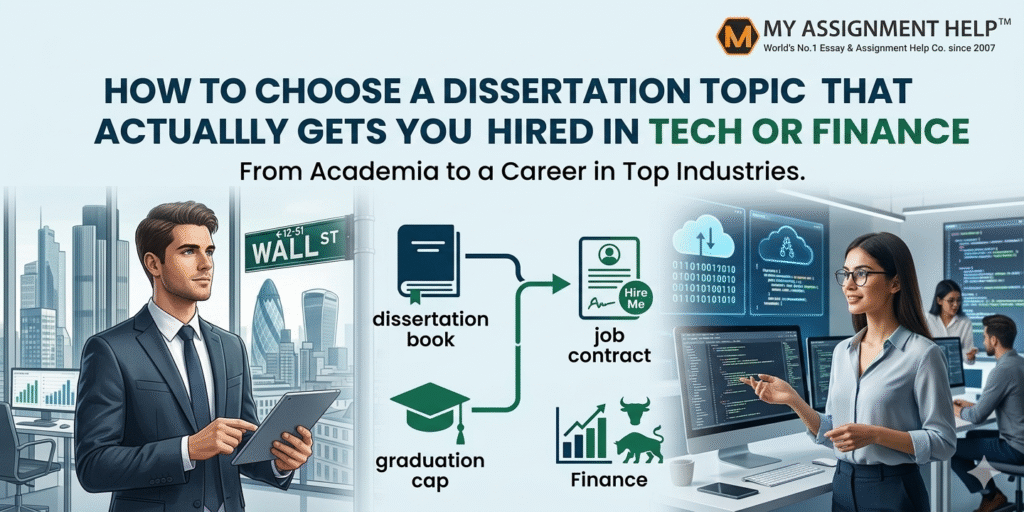
For many postgraduate students in the United States, a dissertation is viewed merely as the final hurdle to graduation. however, in high-stakes industries like Fintech, Quantitative Finance, and Data Science, your dissertation is actually your most potent branding tool. It is the only 100+ page document that proves you can identify a high-value problem, analyze complex data sets, and provide actionable insights—skills that are identical to those required in C-suite advisory or senior engineering roles.
The shift toward “skills-based hiring” in 2024 and 2025 means that recruiters at firms like Goldman Sachs or NVIDIA are less interested in your GPA and more interested in your “Proof of Concept.” A well-chosen topic doesn’t just earn you a PhD or Master’s; it serves as a long-form white paper that demonstrates your readiness for the workforce.
Selecting a topic that bridges the gap between academic rigor and market demand requires a strategic approach. If you find yourself overwhelmed by the technical requirements of structuring such a massive project, seeking professional dissertation help can ensure your research remains aligned with current industry standards. By collaborating with experts who understand both pedagogical requirements and market trends, you can produce a paper that stands out to both your university chair and future employers.
The Intersection of Industry Needs and Academic Research
To get hired in Tech or Finance, your topic must solve a “Pain Point.” In Finance, this currently revolves around risk mitigation, algorithmic efficiency, and ESG (Environmental, Social, and Governance) data integration. In Tech, the focus is on Scalable AI, Cybersecurity ethics, and Cloud Optimization.
When drafting your proposal, consider the “Functional Utility” of your research. If a hiring manager at a top-tier firm reads your abstract, will they see a solution to a problem they are currently facing? This is where many students struggle, balancing the theoretical depth required by the university with the practical application demanded by the market. Using a reliable assignment help service can provide the foundational support needed to balance these two worlds, allowing you to focus on the high-level data analysis that will eventually impress recruiters.
Step-by-Step Guide to Selecting Your Topic
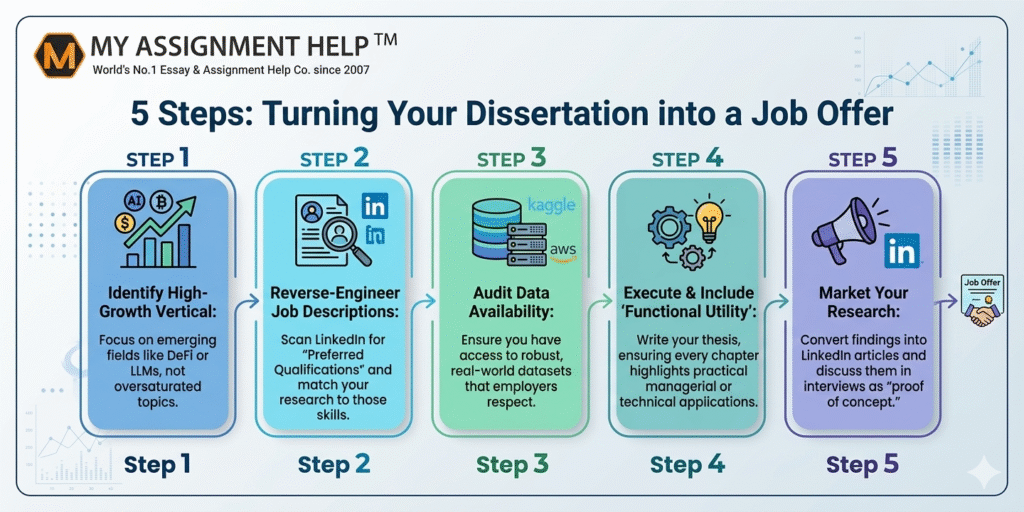
1. Identify “High-Growth” Verticals
Don’t choose a broad topic like “The History of Banking.” Instead, look at emerging niches.
- Finance: Predictive Analytics in High-Frequency Trading (HFT) or the impact of Decentralized Finance (DeFi) on traditional liquidity pools.
- Tech: Edge Computing in Autonomous Vehicles or Large Language Model (LLM) Bias Mitigation.
2. Reverse-Engineer Job Descriptions
Go to LinkedIn or Indeed. Look at the “Preferred Qualifications” for Senior Analyst or Lead Developer roles. If they ask for “Experience in Predictive Modeling for Credit Risk,” your dissertation should be “A Comparative Study of Neural Networks vs. Logistic Regression in Credit Risk Assessment for Mid-Cap Lenders.”
See also: Business Technology Trends in 2025
3. Data Availability vs. Data Originality
Tech and Finance firms value data literacy. Ensure your topic allows you to work with Python, R, or SQL. Using proprietary or under-utilized datasets (like Kaggle’s financial datasets or AWS Open Data) proves you can handle real-world “messy” data.
Key Takeaways for Career-Centric Research
- Niche over Broad: Specificity signals expertise.
- Tool-Centric: Mention the technologies you used (Python, Tableau, STATA) in your methodology.
- Outcome-Oriented: Your conclusion should provide a “Managerial Implication” or a “Technical Recommendation.”
- Publishability: Aim for a topic that could be condensed into a LinkedIn article or a Medium post to build your digital footprint.
Data-Driven Insights: What the Markets Want
According to recent industry reports, the demand for specialized roles in AI and Financial Technology is expected to grow by 22% through 2030 (U.S. Bureau of Labor Statistics). Furthermore, a 2024 survey of hiring managers indicated that 68% of employers in technical fields prioritize “project-based evidence of skill” over institutional prestige.
| Industry | High-Demand Research Area | Why It Gets You Hired |
| Fintech | Real-time Fraud Detection Systems | Combines Cybersecurity with Financial Logic |
| Big Tech | Ethics in Generative AI | Addresses current regulatory and compliance fears |
| Finance | Climate Risk Modeling | Aligns with mandatory ESG reporting trends |
| SaaS | Natural Language Processing (NLP) | Essential for the next generation of customer UX |
FAQ Section
Q: Can I change my dissertation topic if I’ve already started?
A: Yes, but it is best to pivot early. If your initial data is weak or the topic feels outdated for the current job market, consult with your advisor about refining the scope rather than starting from scratch.
Q: Does the “Brand” of my topic matter more than the grade?
A: For your career, yes. A “B” grade on a cutting-edge topic in Blockchain Security is often more valuable to a tech firm than an “A” on a generic study of 1990s software development cycles.
Q: How do I prove my dissertation is “Industry Ready”?
A: Include a “Practical Applications” chapter. Explicitly state how a company could use your findings to save money, increase speed, or reduce risk.
About the Author
Dr. Sarah Jenkins is a Senior Academic Consultant and Lead Content Strategist at MyAssignmentHelp. With over 12 years of experience in higher education and a PhD in Organizational Behavior, Dr. Jenkins specializes in bridging the gap between academic theory and professional practice. She has helped thousands of students in the US and UK navigate the complexities of dissertation writing, ensuring their work is both scholastically sound and career-optimized.
References and Sources
- U.S. Bureau of Labor Statistics (2024). Occupational Outlook Handbook: Computer and Information Research Scientists.
- Harvard Business Review (2023). “Why Skills, Not Degrees, Are the Future of Hiring.”
- World Economic Forum (2024). The Future of Jobs Report.
- Journal of Financial Transformation (2025). The Impact of AI on Quantitative Analysis.